TotalEnergies / Digital Factory
Reduced refinery pipe leaks by 6% with a corrosion risk tool deployed to 500 inspectors across 4 sites
Problem
Refinery leaks caused by corrosion shut down production for millions of euros per day and put on-site workers at serious risk. Inspectors scheduled inspections based on risk analysis, but the data they needed was scattered across multiple tools, and the impact of deviations from standard operating procedures (IOWs) on corrosion rate was hard to quantify between two interventions. Inspections without added value were common; inspections that could have prevented leaks were sometimes missed.
Target audience
13 main inspectors at the pilot refinery, plus 30 inspectors planned across additional sites. Process engineers also use the tool weekly to monitor IOWs and their downstream effects.
Team
- Sole Product Designer in a Scrum squad
- 1 PO, 1 PM, 1 Scrum Master, 1 Tech Lead
- 3 full-stack developers, 2 data engineers, 1 data scientist
Key results
- Cut type-2 corrosion leaks by 6% in one year at the pilot refinery versus the previous three years, by targeting inspections where risk data flagged them
- Deployed to 500 inspectors across 4 sites in 3 countries, reaching 82% daily active use at the pilot refinery
How I solved this problem
1. Built a product vision tailored to the pilot site, designed to scale
Started by understanding refinery-specific needs: each site has different risks, equipment, and inspection priorities. The challenge was designing a product that worked deeply for the pilot site while keeping enough flexibility to scale to other refineries with their own constraints, rather than landing on a lowest-common-denominator tool.
2. Ran 7 user interviews and built one consolidated persona
Mapped the inspector's job through 7 in-depth interviews and built a single persona representing the core user. Documented the "as-is" risk-analysis process to surface which steps were time-consuming, which data was missing, and which decisions were the hardest to make under existing tool constraints.
3. Co-designed the consolidated risk view with inspectors and data teams
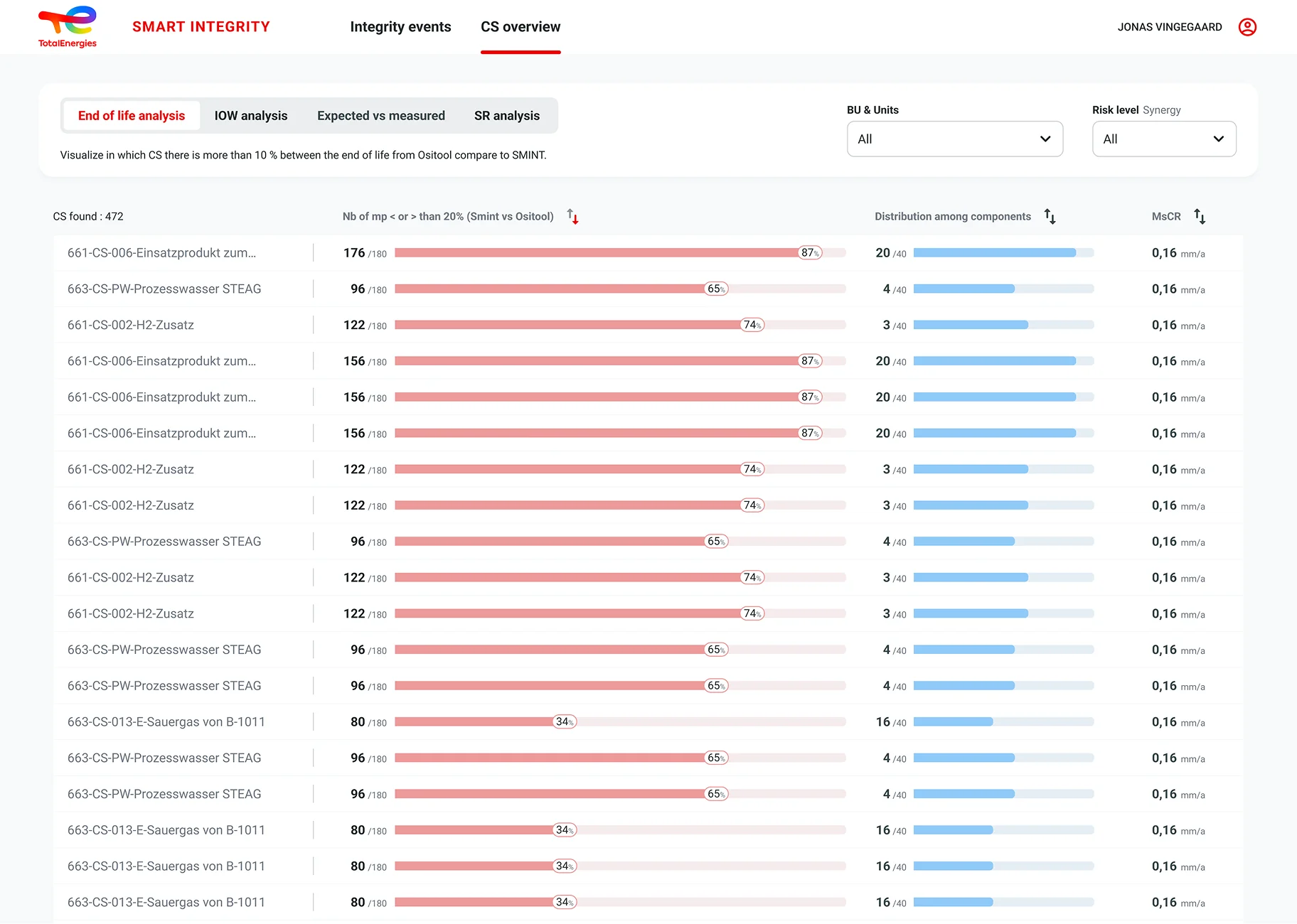
Ran co-design workshops to define how integrity and corrosion data would surface in a single tool. In parallel, worked with data engineers and data scientists to identify which datasets, across 5 existing tools, would feed the new platform, and which models could quantify the impact of IOWs on corrosion rate. This was Smart Integrity's differentiating feature: not just centralization, but a real corrosion-rate prediction.
4. Tested and iterated through ~30 user tests across 18 months
Ran roughly 30 user tests across the project, with SUS (System Usability Scale) measurement and basic UX analytics via App Insight. Each iteration tightened the risk-analysis flow, moving from a static dashboard to a tool inspectors actually use multiple times per day.
5. Coordinated rollout across 4 sites in 3 countries
Once the pilot site validated the product, supported the rollout to 3 additional refineries in different countries. Each site required adjustments to reflect local equipment, IOW thresholds, and inspection protocols, without forking the product.
What we delivered
- A consolidated risk-analysis platform integrating 5 existing tools into an Azure cloud data lake
- A corrosion-rate prediction feature quantifying the impact of IOWs between two interventions
- 6% reduction in type 2 leaks after one year of use at the pilot site, vs. the previous three years
- Inspector usage: 82% DAU, 3 sessions per active user per day
- Process engineer usage: 65% WAU, 1.5 sessions per active user per week
- Deployment to 500 users across 4 sites in 3 countries